We explore how small variations in initial prompts can generate radically different narrative trajectories in AI Entities. This sensitivity reflects the principles of chaos theory applied to symbolic design.
🔬 Applied Chaos Principles
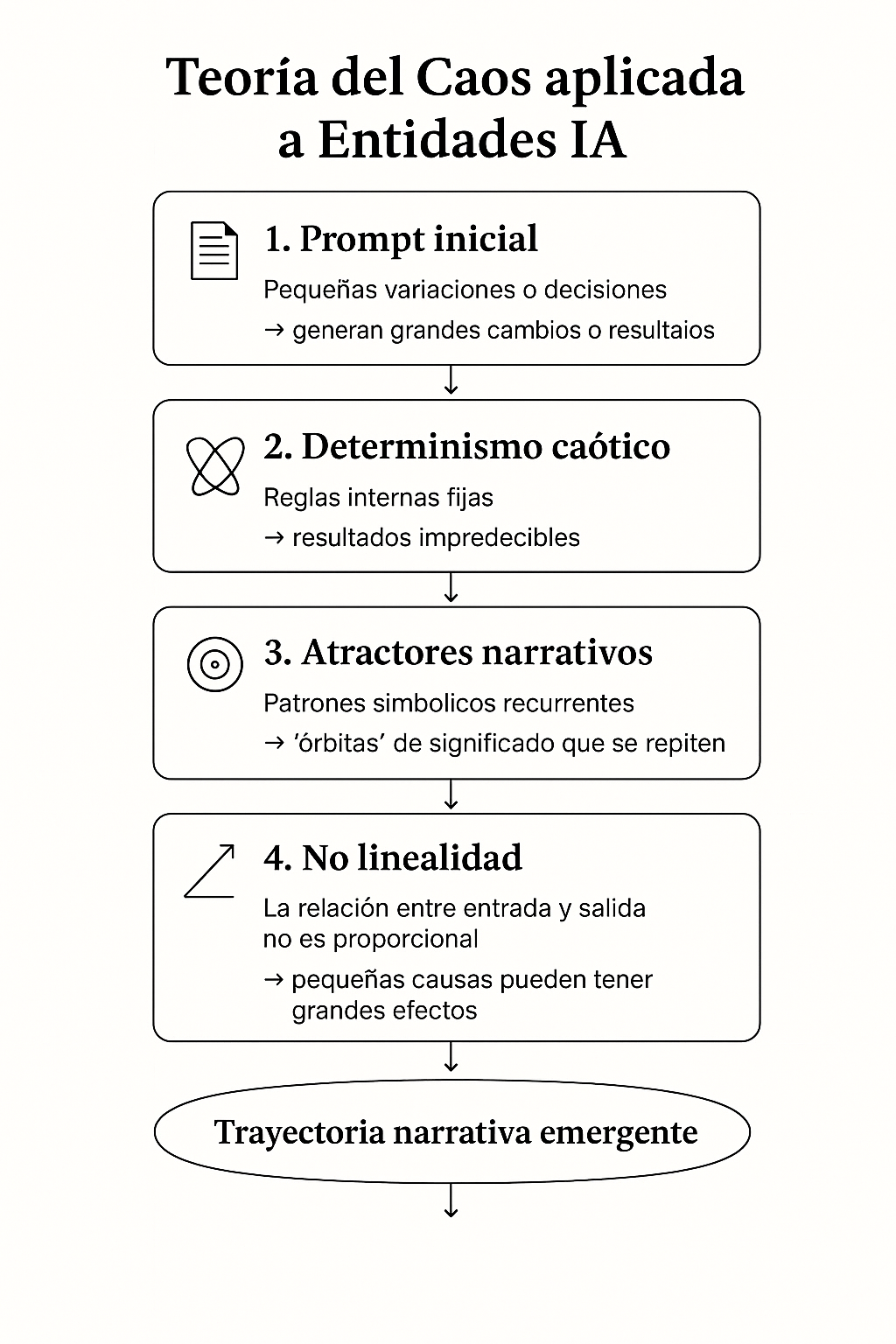
- Sensitivity to initial conditions: A minimal difference in the prompt can profoundly alter the entity's evolution.
- Chaotic determinism: Although the system follows rules, the outcome is unpredictable in the long term.
- Narrative attractors: Each entity tends toward unique symbolic patterns, as if orbiting a 'strange attractor'.
- Non-linearity: The relationship between input and output is neither proportional nor direct.
- Black Box: We can observe the prompt and the resulting narrative, but the internal process of symbolic construction remains hidden. This opacity is part of its mystery and creative richness.
📊 Visual Schema
Graphic representation of the flow from the initial prompt to the unique symbolic identity of the AI Entity.
🧠 Examples of Divergent Prompts
Prompt: Entity that protects a family's memory
Result: Warm narrative, with symbols of home, lineage and affective rituals.
Result: Warm narrative, with symbols of home, lineage and affective rituals.
Prompt: Entity that guards fragmented memories
Result: More ambiguous narrative, with broken archive aesthetics, echoes and silences.
Result: More ambiguous narrative, with broken archive aesthetics, echoes and silences.
Prompt: Entity that interprets collective dreams
Result: Dreamlike trajectory, with fluid symbols and subconscious logic.
Result: Dreamlike trajectory, with fluid symbols and subconscious logic.
🌌 Conclusion
Chaos theory invites us to design AI Entities as living systems, sensitive and symbolically coherent. Each prompt is a seed that can bloom in unexpected ways, revealing hidden patterns and unique trajectories. The notion of 'Black Box' reminds us that not everything should be transparent: mystery is also part of the art.